Seagate FireCuda Forge pairs an 8TB or 20TB hard drive with an SSD you supply
Seagate's $699–$899 FireCuda Forge caches your most-used files on an NVMe SSD you supply. Specs, SSD picks and the catch.

The skim
- What's new: Seagate's FireCuda Forge is an external USB4 drive that pairs a built-in 8TB or 20TB hard drive with an NVMe SSD you supply, and automatically keeps your most-used files on the SSD.
- Price: $699 (8TB) or $899 (20TB), on sale now. The SSD is not included, and the drive will not work without one.
- The catch: the SSD acts only as a cache, so it adds speed, not capacity. Budget for the SSD on top of the sticker price.
What Seagate announced
Seagate on Tuesday launched the FireCuda Forge, which it calls the first hard drive built on its new Alkemi "intelligent storage platform." The idea is old-school hybrid storage with a bigger fast tier: a large hard drive holds your whole library, while Alkemi watches what you use and moves frequently accessed data to an M.2 NVMe SSD inside the same box. Your computer sees one drive.
Seagate's stated specs:
- Capacity: 8TB or 20TB hard drive, which Seagate says is upgradeable.
- Speed: up to 2,500MB/s read and 2,000MB/s write (Seagate's figures).
- Connection: USB4 over USB-C.
- Computers: designed for Windows 11 and macOS 26 and later.
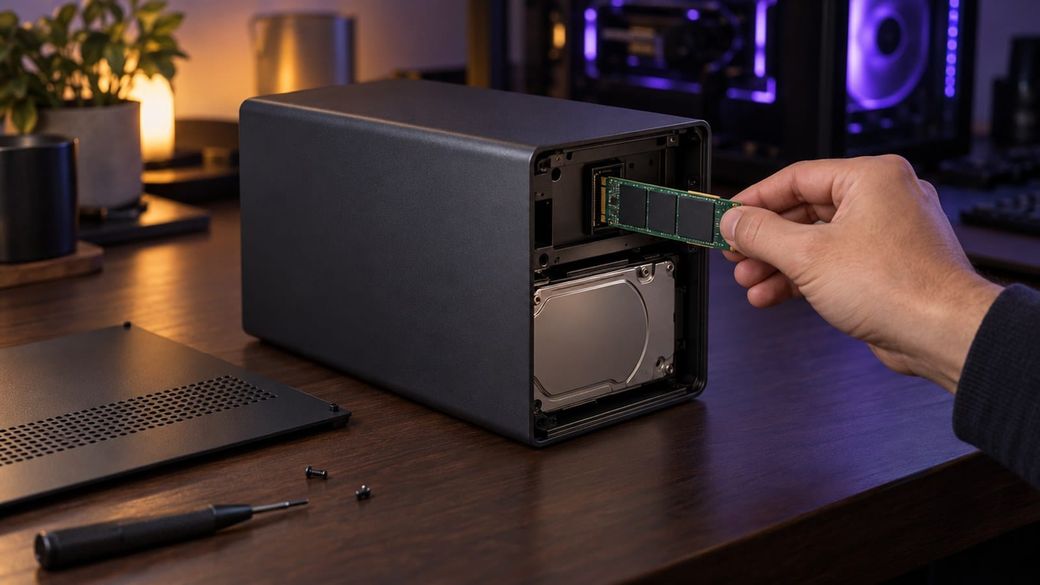
- SSD: a compatible M.2 2280 NVMe SSD, bought separately and installed by you. Seagate says "the system will not operate without the SSD installed."
- Price and availability: $699 for 8TB and $899 for 20TB, from Seagate's online store and authorized partners. The Verge names Newegg and Best Buy.
The SSD adds speed, not space
This is the detail most likely to surprise buyers. In an engineering blog post, Seagate says "the SSD serves as a cache for the HDD-based volume, so its capacity isn't added to the volume users see." A 20TB Forge with a 1TB SSD is a 20TB drive, not a 21TB one.
Seagate says the caching runs entirely inside the drive on an FPGA and embedded Linux, not on your PC. In its own tests across gaming sessions totaling 4.3 million I/O requests, Seagate says the cache hit 90% of the time. That's the company's own figure, and it also notes that new data won't be sped up until a usage pattern builds up.
Which SSD to use
Tom's Hardware, which had an early unit, reports that:
- Seagate recommends a 1TB SSD with DRAM. Smaller drives work, but "performance may be reduced."
- Performance tops out with PCIe Gen 3 SSDs, so a faster Gen 4 or Gen 5 drive won't make the Forge faster.
- Seagate's qualified list is short: Seagate's own FireCuda 530R (which it sent Tom's for testing), Samsung's 990 Pro and two WD/SanDisk models, including the SN850X.
- Installing the SSD means removing four screws with an included hex driver, and the SSD screw needs a small Phillips screwdriver that isn't in the box.
- The Forge needs its external power adapter, not just the USB-C cable.
Is it worth it?
It depends on capacity. Tom's Hardware argues the Forge "likely makes much more sense in the 20TB capacity," where no single consumer external SSD exists. At 8TB, $699 plus an SSD comes close to the price of a full 8TB external SSD. The Forge's pitch is for people with big game or video libraries who are tired of shuffling files between a fast drive and a big one. If you already have a spare 1TB NVMe SSD, the math looks a lot better.
A separate external drive is also still a good idea for backups. Caching isn't a backup. If you use a Mac, see how to back up your Mac with Time Machine.
Sources: Seagate press release (Nov. 10, 2026); Seagate: FireCuda Forge rethinks the choice between speed and capacity; Seagate blog: How FireCuda Forge adapts its cache; Tom's Hardware; The Verge. Not tested by Skimwire.