Apple's new AI health study wants 200,000 iPhone users. Here's what you'd share
Apple's Health AI Usage Study uses OpenEvidence to answer health questions. Who can join, what data it sees, and how it compares with ChatGPT Health.

The skim
The Apple Health AI Usage Study is a free, U.S.-only research app that answers your health questions using OpenEvidence's clinical AI, with citations. You need to be 21 or older with an iPhone 15 Pro or later on iOS 26 or later. Sharing Health data is optional, and Apple says study data won't train AI models.
What is the Apple Health AI Usage Study?
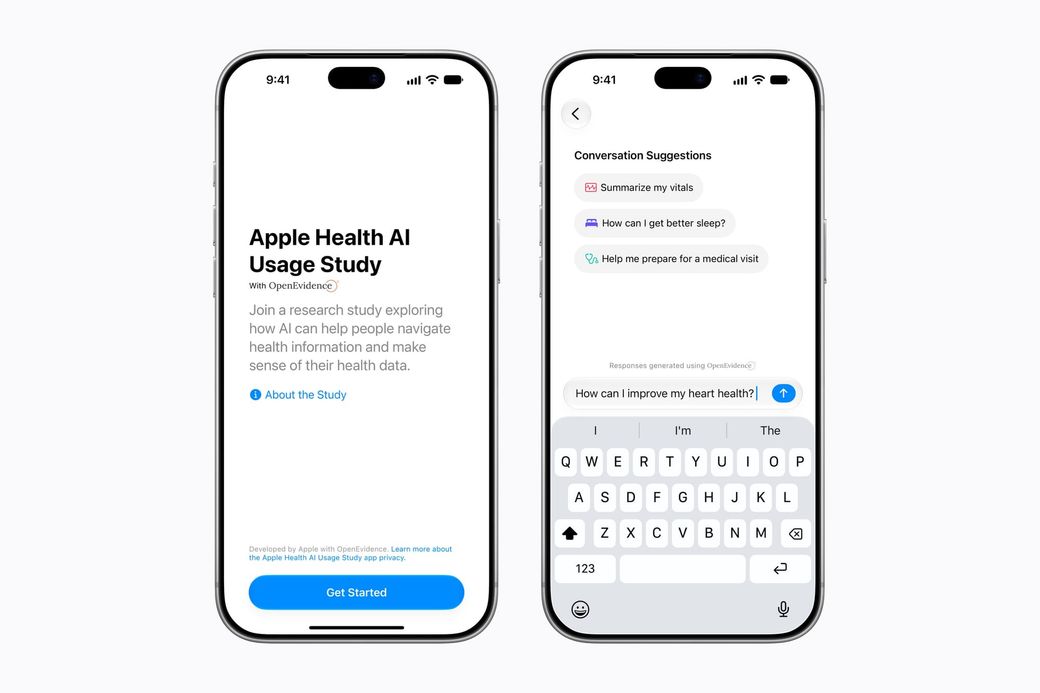
Apple announced the Apple Health AI Usage Study on Nov. 15, 2026. It's a virtual research study run through a new, separate iPhone app called Apple Health AI Study App. Apple wants to learn what makes people trust a health chatbot, whether they understand its answers, and whether those answers change what they actually do.
The answers come from OpenEvidence, a clinical AI platform built for doctors. Apple designed the app experience around it. Apple is looking for up to 200,000 participants, and Fierce Healthcare reports that people can stay enrolled for up to 12 months.
This is not a new Apple Intelligence feature, and it isn't Siri. The Verge reports that the app is text-based and isn't integrated with Siri or Apple Intelligence. You can still dictate with the keyboard mic.
Who can join Apple's AI health study?
Apple lists three requirements in its announcement:
- Age: 21 or older. The App Store listing is rated 18+, but the study itself requires 21+.
- Location: the United States.
- iPhone: an Apple Intelligence-capable model, meaning iPhone 15 Pro or later, running iOS 26 or later.
The iPhone 15 Pro rule is the catch for many people. A standard iPhone 15, iPhone 14 or older won't qualify, even though the app itself doesn't use Apple Intelligence. The app is iPhone-only. Apple doesn't list an iPad or Apple Watch version.
How do I join the Apple Health AI Usage Study?
- On an eligible iPhone, open the App Store and search for "Apple Health AI Study App." The seller should be Apple Inc. (direct link).
- Download the free app (29.9 MB) and read "About the Study" before you tap Get Started.
- Complete onboarding. Fierce Healthcare reports this includes informed consent and demographic questions such as age, race and education.
- Decide what Health data to share, if any. You can join without sharing HealthKit data.
- Ask questions and rate the answers. Apple also sends baseline and monthly surveys, per Fierce Healthcare.
What health data does the study app see?
Only what you choose to share. Apple says participants can share HealthKit data types such as resting heart rate, activity, sleep or lab results, so answers can reflect their own numbers. According to Fierce Healthcare, if you've imported clinical records into the Health app and separately agree to share them, the app can use that information, mainly lab results.
Apple describes the privacy path this way, as reported by Fierce Healthcare:
- Your question is first processed on the iPhone to remove identifying information.
- It then goes to a secure study environment run by a third-party study support contractor, where it's de-linked from your participant ID and screened again.
- Only then is it sent to OpenEvidence, which generates the answer from its reference material.
The App Store privacy label (checked Nov. 16, 2026) says identifiers (a user ID) may be linked to you for app functionality and analytics. Diagnostics and performance data are collected but not linked to you. Apple says the study is overseen by an independent review board.
Apple's health AI study vs. ChatGPT Health: what's different?
Both let you ask health questions grounded in your own data, and both say they won't train AI on your health chats. The differences are in who can use them, what powers the answers, and what you give back. Here's how they compare, based on Apple's announcement and OpenAI's ChatGPT Health page (both checked Nov. 16, 2026):
| Apple Health AI Study App | ChatGPT Health | |
|---|---|---|
| What it is | A research study with its own app | A dedicated Health space inside ChatGPT |
| Who can use it | U.S., 21+, iPhone 15 Pro or later on iOS 26+ | U.S. users 18+ on web and iOS (OpenAI update dated July 23, 2026) |
| Answers come from | OpenEvidence clinical AI, with linked peer-reviewed citations | OpenAI's models, shaped with feedback from 260+ physicians |
| Personal data you can add | HealthKit data (heart rate, activity, sleep, lab results); imported clinical records with separate consent | Medical records via b.well, Apple Health, and apps like MyFitnessPal and Function |
| Used to train AI? | No, says Apple | Health chats aren't used to train foundation models, says OpenAI |
| What you give back | Consent, demographics, answer ratings, monthly surveys | Nothing required beyond a ChatGPT account |
| How long | Up to 12 months in the study (per Fierce Healthcare) | Ongoing product |
| Price | Free | Included with ChatGPT plans, including Free (per OpenAI's launch page) |
The big philosophical difference: Apple's app is an experiment it's measuring, not a finished product. You're a research participant, and your ratings and survey answers are the point. Neither tool is meant to diagnose or treat anything, and both say so.
Is there a real benefit to joining?
For some people, yes. The app's citations link to peer-reviewed sources, and OpenEvidence draws on licensed medical literature. Fierce Healthcare names partnerships with The New England Journal of Medicine, JAMA, Nature, Cochrane and NCCN. That's a different foundation from a general chatbot answering from the open web.
The appointment-prep tools look like the most practical feature. Apple says the study will test whether health AI helps people prepare for visits with their own doctors, and the app's suggested prompts include "Help me prepare for a medical visit." For the trade-offs of handing your data to other wellness services, see our Whoop privacy settings guide.
Context matters too. Fierce Healthcare cites a KFF survey finding that roughly 1 in 3 U.S. adults have used an AI chatbot for health information. Apple's study is one of the first at this scale to measure what happens after people get those answers.
Our take: should you join?
- Join if you have an eligible iPhone, already ask chatbots health questions, and are comfortable with monthly surveys. You get cited answers and you help shape how Apple builds health AI.
- Join, but share less if you're curious but cautious. You can enroll without sharing HealthKit data or clinical records, and add them later if the answers seem worth it.
- Skip if you don't want to hand over demographics, rate answers or fill out surveys for a year. A research study asks more of you than a regular app. If you mainly want an assistant that reads your records, ChatGPT Health is the closer fit; see what AI tools can see in our ChatGPT and Gemini wallet privacy guide.
- Don't upgrade your phone for this. It's a free study, not a feature. If you're weighing an Apple Intelligence iPhone anyway, our Apple Intelligence coverage explains what you actually get.
More consumer AI explainers live in our AI coverage.
FAQ
Who can join the Apple Health AI Usage Study?
Adults 21 or older in the United States with an Apple Intelligence-capable iPhone, meaning iPhone 15 Pro or later, running iOS 26 or later. Apple is enrolling up to 200,000 participants through the free Apple Health AI Study App on the App Store.
Does Apple's AI health study app use Apple Intelligence or Siri?
No. The Verge reports the app isn't integrated with Siri or Apple Intelligence; answers are generated by OpenEvidence's clinical AI. It still requires an iPhone 15 Pro or later. You type questions, or dictate them with the keyboard microphone.
Will Apple use my health data to train AI?
Apple says study data will not be used to train AI models. Sharing HealthKit data and survey responses is optional. Apple says questions are stripped of identifying details on the iPhone and de-linked from your participant ID before they reach OpenEvidence.
Is the Apple Health AI Study App free?
Yes. The App Store lists it as a free, iPhone-only app from Apple Inc. It requires iOS 26 or later. In exchange, participants complete onboarding, rate answers and answer baseline and monthly surveys, and can stay in the study for up to 12 months.
Can the app diagnose medical conditions?
No. Apple says the app is not meant to diagnose or treat any condition or replace a medical professional, and it suggests following up with a provider when it detects concerning questions. Use it to understand information and prepare questions for your doctor.
Skimwire has not used the Apple Health AI Study App. Details come from Apple's Nov. 15, 2026 announcement, the App Store listing, OpenAI's ChatGPT Health page and reporting by Fierce Healthcare and The Verge, all checked Nov. 16, 2026. This article is not medical advice and has no affiliate links.